

Roof Repair or Roof Replacement? How to Tell Which Your Roof Needs
On this page · 9 sections
A leak shows up on the ceiling, or a windstorm peels back a few shingles, and the first question every homeowner asks is the same: can this be fixed, or am I looking at a whole new roof? It's a fair question, and it deserves a straight answer rather than a sales pitch. Roofs in western Montana work hard — heavy snow, long winters, and a freeze-thaw cycle that works at every seam — but a roof that took a hit is not the same as a roof that's finished.
The answer usually comes down to five things: how old the roof is, whether the damage is in one place or many, what the surface looks like, what's going on underneath, and what you want from the house over the next several years. Work through them in order and most homeowners can tell which side of the line they're on before anyone climbs a ladder.
The short answer
Bottom Line Up Front
If the roof is early in its life and the damage is in one spot, repair it. If the roof is near the end of its life, the damage is spread across several slopes, or the decking underneath is going soft, a repair only buys time. Replace it.
A repair is the right call more often than many homeowners expect. But there comes a point where every patch is money spent on a roof that's failing anyway. The trick is knowing which side of that point your roof is on before a Montana winter makes the decision for you, and a free inspection is the easiest way to find out.
repair or replacement
warranty, through the manufacturer
warranty
The rest of this post walks through the five questions behind that answer, with a decision matrix at the end that pulls them together in one table.
Question 1: How old is the roof, and what is it made of?
Age is the biggest single factor, and it's the one homeowners most often don't know. If you have paperwork from the last roof, dig it out. If the roof came with the house, the home inspection report or old listing photos can usually narrow it down, and we can read the wear on-site during an inspection.
What the roof is made of matters just as much, because asphalt shingles and standing seam metal age on very different clocks. Our post on how long different roofing materials last goes into the details. The rule of thumb is simple: a roof early in its expected life with a problem in one spot is a repair. A roof near the end of its life is a system wearing out all at once, and fixing one leak just moves you on to the next one.
Repair vs. replace at a glance
Here's the comparison we'd sketch out with you on-site. Each row is a factor that can drive the decision, and the highlighted column is the smarter call when that factor is the one that matters most to you.
| Factor | Lean Repair | Lean Replace |
|---|---|---|
| Roof age | Early in its expected life | Near or past its expected life |
| Where the damage is | One spot or one slope | Several slopes or the whole roof |
| Surface condition | Flat, intact, holding granules | Curling, cracking, shedding granules |
| Leak history | First leak, one clear cause | Repeat leaks in different rooms |
| Decking underneath | Solid, no daylight in the attic | Soft spots, sagging, daylight |
| Your plans | Selling in the next few years | Staying for the long haul |
| Material | Happy with what's up there | Ready to switch to standing seam metal |
Your roof will probably fit more than one row. The right call is whichever column wins the most of your rows.
Some grit in the gutters is normal. Heavy piles of dark granules, the sandy coating that protects asphalt shingles from the sun, mean the shingles are wearing out across the roof. If your downspouts are washing out handfuls of granules, that's a replacement conversation, not a repair one. And please stay off a snowy or icy roof; binoculars or a phone zoom from the yard will tell you plenty.
Question 2: Is the damage in one spot or spread across the roof?
A cracked vent boot, flashing that pulled loose around a chimney, or a handful of shingles a windstorm lifted — that's localized damage, and localized damage is exactly what roof repairs are for. We fix the cause, not just the stain on the ceiling, and you get more years out of a roof that still has them. If the damage came from a storm, read our post on storm damage and your insurance policy before you pay for anything out of pocket.
The picture changes when the same failure shows up in several places. Dried-out boots on more than one pipe, lifted shingles on the front and back slopes, flashing failing at the chimney and the skylight — that isn't bad luck in one spot. It's a roof reaching the end of its service life across the board, and patching one of five failures buys you very little time.

Question 3: What is the roof surface telling you?
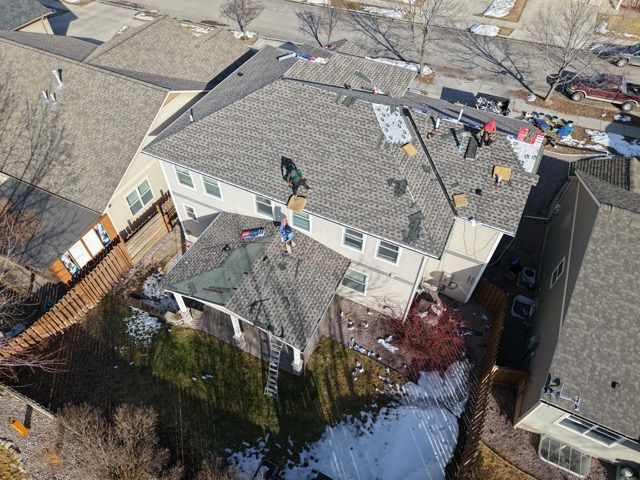
Stand at the curb and look up. Healthy asphalt shingles lie flat, run in straight lines, and have an even color. Worn-out shingles give themselves away: corners curling up, cracks and brittleness from years of freezing and thawing, and bald, lighter patches where the granules have washed off. A few worn shingles in one area can be swapped out. When the whole field looks like that, the shingles have lost the flexibility and protection they need to keep shedding snowmelt, and the signs in our post on spotting a failing roof start to add up fast.
Signs it's a repair
The roof has life left and the problem is contained. Fix it and move on.
What we look for
- One leak traced to one cause, such as a cracked vent boot, loose flashing, or a few wind-lifted shingles.
- The shingles around the damage still lie flat and hold their granules.
- The roof is still early in its expected life for its material.
- The attic shows no daylight, no soft spots, and no sag in the roofline.
Signs it's a replacement
The roof is wearing out as a whole. Patching buys months, not years.
What changes the answer
- A second or third leak, showing up in a different part of the house each time.
- Curling, cracking, and bald patches across more than one slope.
- Gutters and downspouts washing out heavy piles of granules.
- Soft decking, a sagging roofline, or daylight visible from inside the attic.
Question 4: What's going on underneath?
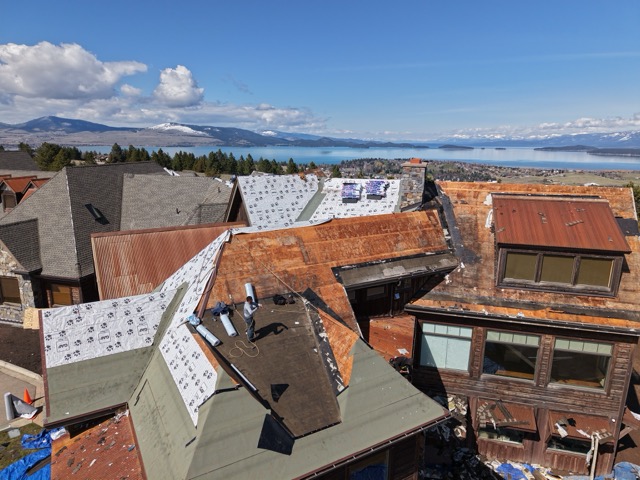
The shingles are only the top layer. Under them sits the underlayment, and under that the wood decking that holds everything up. A repair makes sense when that deck is solid. If you can see daylight from the attic, the ceiling has soft spots or water stains in more than one room, or the roofline sags between rafters, the problem has moved past the surface. That's a job for a full roof replacement, where the old roof comes off and the deck can be inspected and repaired before anything new goes on.
Be wary of anyone who tells you "repair" or "replace" after a glance from the street, especially when they push you to sign that day. A roof that truly needs replacing will still need it next week. Ask the company for references, ask to see a job they've finished, and make sure the crew is certified by the manufacturer — whether that's Malarkey, Owens Corning, or GAF — so a new roof comes with the warranty the manufacturer actually backs. Our post on choosing the right roofer covers what to ask.
Question 5: What do you want from the house next?
This is the tiebreaker, and only you can answer it. If the roof could honestly go either way, think about how long you're staying. Selling soon? A clean, documented repair keeps the house dry and lets the next owner make the bigger call. Planning to stay for the long haul? Replacing on your own schedule beats replacing in an emergency in the middle of winter. A replacement is also the moment to rethink the material entirely: plenty of homeowners who called about a leaking shingle roof end up choosing standing seam metal instead.
“When a roof could go either way, we stop asking about the shingles and start asking about you. How long you’re staying, and what you want the house to look like, is usually the answer the roof can’t give on its own.”— Western Montana Roofing
The decision matrix
If you only use one part of this post, use this table. Find the rows that describe your roof and see which column wins. Most roofs fit more than one row, so the right pick is whichever column wins the most of your rows.
| If your roof… | Repair | Replace |
|---|---|---|
| Is early in its expected life | Yes | Premature |
| Is near the end of its expected life | Stopgap only | Yes, usually |
| Has one leak with one clear cause | Yes | Overkill |
| Leaks in more than one room | No | Yes |
| Is shedding granules everywhere | No | Yes |
| Has soft or sagging decking | Not safe to patch | Yes |
| Is on a house you'll sell soon | Yes — keep it dry | Buyer's call |
| Is a material you want to move away from | Buys time | Good time to switch |
The bottom line
Plenty of roofs that worry homeowners don't need replacing yet. They need one honest repair and some attention. The ones that do need replacing usually make it clear once you work through the five questions: they're older, they leak in more than one place, the surface is worn across the board, the deck is getting soft, and you plan to stay. When most of those line up, one replacement is drier and simpler than patching your way through another winter.
If you're still not sure, that's what a free inspection is for. We meet you in person, look at the roof, talk it through with you, and send a written bid within a couple of days — a repair if that's what the roof needs, a replacement if it isn't. Curious what the bigger job involves? Read what to expect from a roof replacement, or browse our recent projects.